Head of Marketing, Beverley Scott, contributes to the staying in touch feature in May 2022’s edition of the AV Magazine…
The Covid pandemic has accelerated the adoption of a number of touchless technologies, including voice, gesture, BYOD and RFID. Paul Bray finds out how they work, and whether end users are really taking to them.
The last two years have witnessed a sea of change in attitudes to interfacing with AV systems without touching them.
“The post-Covid-19 new normal has encouraged an evolution in contactless technologies,” says Jonathan Clark, product marketing manager at Poly. “These solutions have become more ubiquitous than before, with many businesses integrating them to keep their employees safe during the pandemic.”
For many of us, the most ‘natural’ way to command a machine is to talk to it. “People have become accustomed to using voice assistants such as Alexa, Cortana and Siri to check the weather or search the internet on their personal devices, and now voice control is being added to the business world,” says Charlie Jones, global alliance and partnership manager for business communication at Sennheiser.
“Our TeamConnect Intelligent Speaker integrates with Microsoft Teams and allows you to do things such as start a meeting or add participants by using simple phrases such as ‘Cortana, start my meeting’.
“To enable voice control of your meeting room, you first need to teach Microsoft Teams to understand your voice. This takes a few minutes and need only be done once, and your ‘voice profile’ is then stored (subject to your organisation’s IT guidelines), so Teams will recognise your voice in future. The system already recognises 16 languages, with more to come.
“One advantage of modern voice control is that, thanks to machine learning, the system gets more accurate every time you use it. Security can also be enhanced, as it’s harder to reproduce someone’s voice than to steal a password.”
Voice commands are seldom processed locally, according to Stijn Ooms, director of product strategy for AV and digital workplace at Crestron.
“Nowadays, most voice engines are in the cloud. While the data comes from the device, the processing happens at cloud level, so it rarely makes sense to work with local device APIs.”
Apart from the obvious difficulty of using them in noisy environments, the main drawback of voice interfaces is their novelty. “As voice control is still relatively new, it’s not supported by all systems, although the enabled ecosystem is growing daily,” says Jones.
People have been making gestures at computers for decades (mostly of the two-fingered variety), but now the computers are beginning to understand. “Motion controlled user interfaces add a new, touch-free dimension to interactive multimedia display and presentation solutions,” says Markus Zeppenfeld, senior product manager at Christie.
“More and more installations – especially in attractions such as museums, for example – use interaction to make it more of an experience for a visitor to get information about what they’re looking at. The technology is ideal for a range of business, education and entertainment organisations, enabling longer exhibit life spans, and reassuring touch-conscious audiences in the aftermath of the pandemic.”
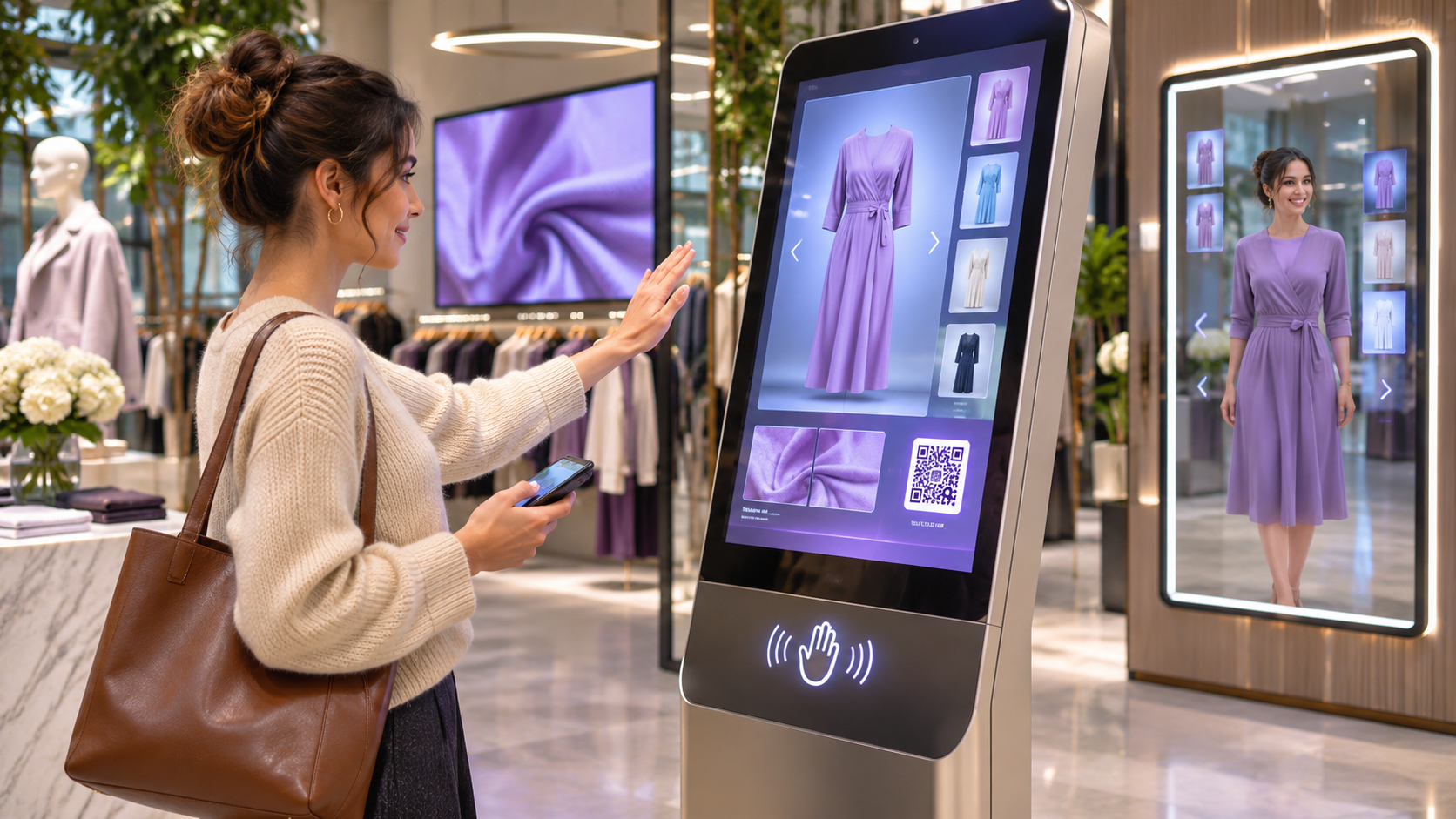
Gesture-based technology uses 3D cameras or optical sensors – either standalone or built into the display – to detect users’ movements, such as pointing, hand waving and finger snapping. It is becoming big business.
“The global gesture recognition and touchless sensing market was worth $13.6 billion in 2021, and is expected to reach $37.6 billion in 2026, according to MarketsandMarkets,” says Beverley Scott, head of marketing at SignStix.
However, some believe that gesture technology has its drawbacks. “People still feel uncomfortable using gesture controls,” says Daniela Dexheimer, senior product manager for collaboration technologies at Sharp NEC Display Solutions. “Users feel inhibited, and gestures would need to be learned, as they’re not intuitive.”
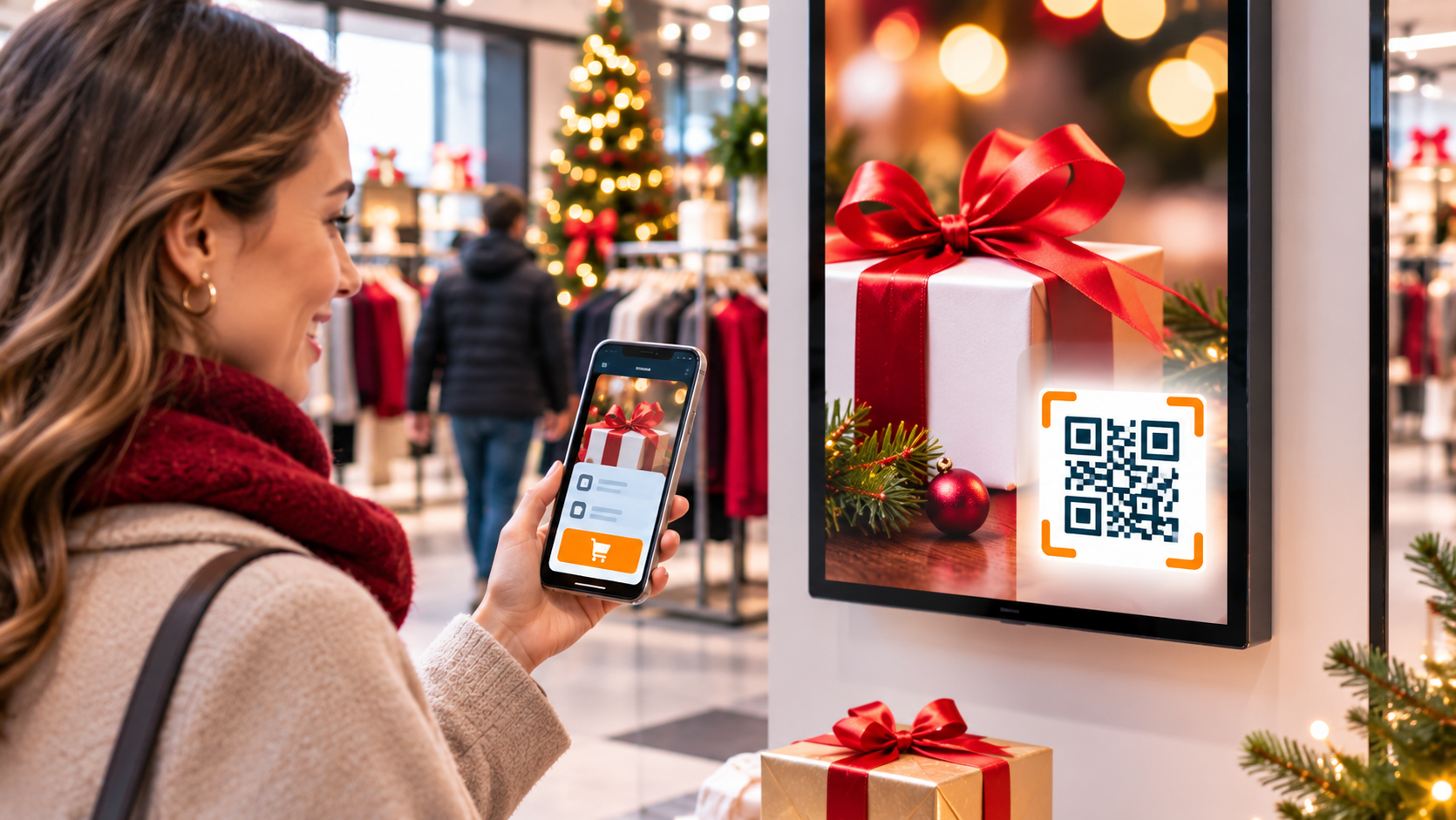
QR codes offer a less controversial method of touchless interaction. “Say a shopper wants to find the click-and-collect department but doesn’t want to touch an interactive display,” says Scott. “By scanning a QR code with their smartphone, an interactive map can be replicated on their device.”
Meeting room systems are also adopting the technology. “When you scan the QR code, all the room and AV control possibilities are transferred to your device,” says Ooms. “And once you’re out of reach, the system automatically disconnects devices from the wireless gateway.”
Wi-Fi provides another means for people to use their own devices instead of touching communal controllers. “Wireless presentation is a great no-touch solution,” says Robert Bird, product manager at Atlona.
“You use Wi-Fi to connect to the meeting room AV system from your personal laptop, tablet or smartphone. Then you can present from that device without having to touch a cable or room
PC keyboard and mouse.
“A receiver takes screen information from the user’s device over the network and outputs it as video to a display. Some of these receivers have additional functionality, such as automatic display control and digital signal capabilities for showing connection details, room scheduling information, or other visual data.”
For basic presence applications, users do not even need their own device: an RFID badge will suffice. “RFID badge scanners and their integration with third-party scheduling apps create a powerful tool to enable efficient real estate planning,” says Ooms.
“Simply scanning your RFID badge enables smoother logging of the movement of people throughout the office, enabling third party applications to easily contact and trace individuals, and determine occupancy density in a room, or the whole facility.”
“The trend is for the end user to have to do as little as possible to connect the tools they need for work, meetings and conferences, and to have a system that’s as plug-and-play as possible – or in this case, just play, without the plug,” says Gergely Vida, founder and CEO of Lightware Visual Engineering.
“Therefore we have to know users’ needs and prepare the system capability in the most intuitive way possible, and trust the integrator to pre-program and set up the system according to local needs.”
If there is a stumbling block for contactless technology in the workplace, it is not usability but users’ wariness. “People are accustomed to using their own devices at home and feel comfortable extending that experience to the office,” says Ooms.
“But at the same time, we see that voice control and facial recognition aren’t really lifting off in the office, because of security concerns. People are hesitant to have a device listening in on their meetings, and they have privacy concerns regarding facial recognition.”
Nonetheless, most observers predict a bright future for contactless. “Following the pandemic, and with the advancement of XR, VR and AR, contactless technology will likely gain more traction and be implemented in more daily use applications,” says Zeppenfeld.
“The upside of this will be that the technology will get cheaper and be easier to use.”
THE TOUCHLESS KIOSK
“AI-powered
kiosks may have speech-to-order voice recognition and use facial recognition to recognise repeat customers and remember personal preferences – some even recognise sign language,” says Beverley Scott, head of marketing at SignStix.
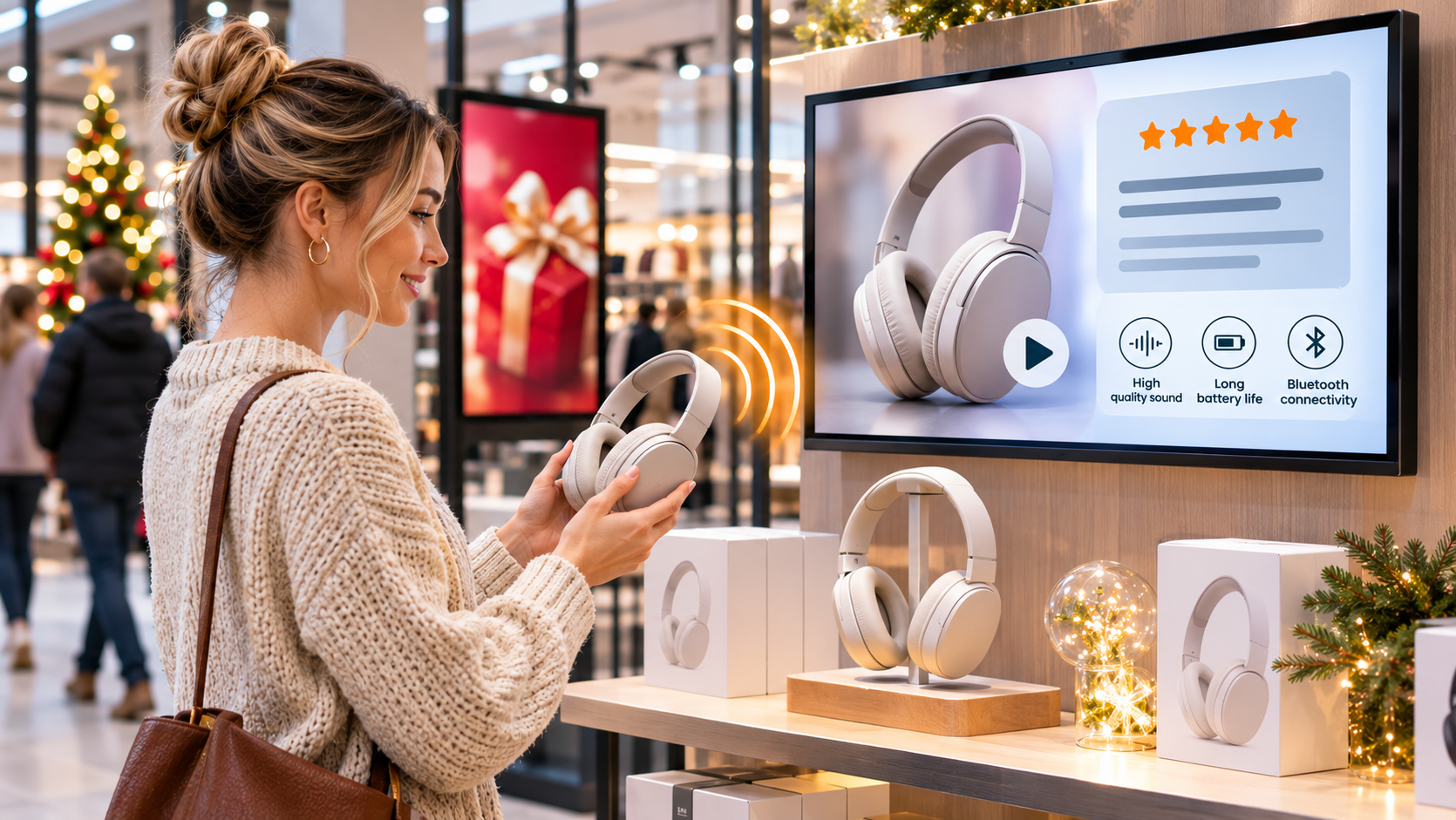
“Customers can select product categories and browse individual items using hand gestures. Scanning a product’s barcode can trigger a variety of content such as videos, reviews, sizing information and further product details. And incorporating a chip-and-pin reader enables customers to transact in-store when a specific product is out of stock.
“When a customer gestures ‘mirror view,’ this automatically hides all signage content, allowing them to try on actual items in front of the same signage display they’ve been interacting with.
“Third-party technologies such as iBeacon and NFC can also be integrated into the kiosk to serve up personalised content to shoppers.”
Read more AV stories
here.
Have a project in mind and would like SignStix to help then our Free Consultation service may help you.
Contact us NOW!